Sunday, November 29, 2009

Hemispheres

Hemispheres
3 min. single channel video

Video consist of abstracted shapes of warm light pulsating in and out of each other. The audio track is built of chimes played at different pitches and coincide with the changes of the shapes. The warm light and sounds are a meditation on the body.

Abduction of Europa


Abduction of Europa
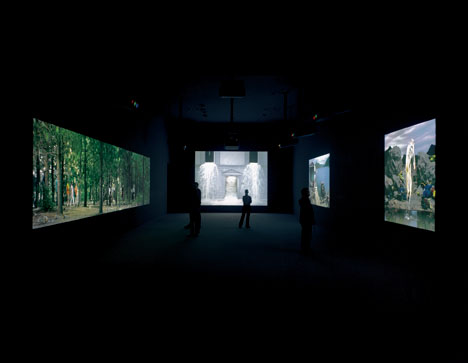
Two channel video projection
3 min. video loop

The concept behind this piece is based off a myth from classical antiquity. According to the myth Europa was abducted by Zeus disguised as a white bull and taken to the heavens where she became a moon goddess. The video loops display the natural elements as they appear to our everyday orientation (i.e. sky projected above, earth projected below) and slowly transform into each other causing a sense of disorientation.

Video channels are projected opposite each other; one channel projected on the ground, the other channel projected on the ceiling. Showing the video in this manner presents the viewer the inability to "see" the whole piece at once making them take part in constructing how the videos relate.

Sunday, October 25, 2009

Bill Viola

Bill Viola
b. 1951
BFA in Experimental Studios: Syracuse University, 1973

Honorary Doctorates:

Syracuse University (1995), The School of the Art Institute of Chicago (1997), California Institute of the Arts (2000), and Royal College of Art, London (2004) among others, and was inducted into the American Academy of Arts and Sciences in 2000


Nantes Triptych, 1992: Video/Sound Installation

The Crossing, 1996: Sound/Video Installation


Catherine's Room, 2001: Color Video on 5 LCD Flat panels mounted on wall

Going Forth by Day, 2002: Five Part Video/Sound installation using 7 projectors and 10 speakers.
"Fire Birth," The Path," "The Deluge," "The Voyage," "First Light"


Ocean Without a Shore, 2007: Video/Sound Installation, Triptych on High-Defintion Plasma Screens


Nine Inch Nails Tour, 2000: Single Channel Triptych
Part 1

Part 2


Sources:
Wikipedia
YouTube
Tate Online
BillViola.com
Catasonic.com
Guggenheim.org

Wednesday, October 14, 2009

Self Portrait


Arduous Delight (3'53")

This video was created from the stand point of a classical self portrait. The frame and surroundings remain still with the figure being fragmented in his movements. The concept for the piece was to bring the viewer into the experience of practice by presenting multiple slivers of time as a single event.

Monday, October 5, 2009

Blog 4

Compression-Fern (Face), Dennis Oppenheim (1970)

This video consists of Dennis Oppenheim standing in the frame visible from about mid stomach up and in front of a pale green background. He is holding branches of a Fern bush in his hands at mid chest level so that the branches fan out covering his face. Throughout the duration of the video Dennis begins to crumple and compress the branches in his hands until eventually they all fit into his grip and nothing of them could be seen, thus revealing his face behind the Fern.

This piece works on multiple levels both as a video and as documentation of an event happening. I think an important element of the piece is the physical struggle Dennis has trying to wrestle with the branches and getting them to compress. I think this piece also works as a portrait in the sense that classical portraiture allows a subject to be the focal element in contrast to its surroundings. Initially the Fern is the subject for the portrait as its form and color contrast dramatically to both the background wall and to the presence of Dennis, which also acts as a sort of background element. Eventually the Fern is taken out of the frame through the compressing and Dennis is left as the portrait subject.

Wednesday, September 23, 2009

A brief history...

I am 27 years old and have been living in San Antonio for the last 5 of those years. Throughout my childhood I grew up in the military and that way of life has allowed me to live all over our country. I have lived everywhere from Hawaii to North Carolina and many places in between. Those experiences have instilled in me a love for travel. It also explains why I desire to move on from San Antonio. I love many of the things I've seen from the many places I've been but I also know that so far I have only seen a facet of what our world is. I've always been the "creative" one in my family and have had great support from them in all that I do, no matter how odd. I can’t imagine pursuing a career in any other field than art, if not art than some other art form whether music, writing, even martial arts. Am not sure if a career in arts will be one that guarantees financial security but I know it’s one that will keep me sane.

Sunday, September 20, 2009

Appropriation, Fair Use and Barbara Kruger


"You are not yourself" Barbara Kruger (1982)

Barbara Kruger is an artist who uses appropriation freely throughout her body of work. All of the materials in the piece presented were taken from some other source not originally of her own creating. Though she did not create any of the materials originally, the way that she brings the parts together, she does not break any laws by presenting the final piece as a work of her own creation. She is able to do so by adhering to the four factors of fair use.
  1. The Transformative Factor: The Purpose and Character of Your Use-- The materials that Kruger takes from are various editorial publications (newspapers, magazines) and the end product that is created is not of the same nature or functional use. By bringing together type from different sources along with imagery that are not originally together Kruger is able to create new context and meaning to be visually read
  2. The Nature of the Copyrighted Work.-- Since the original source materials are taken from objects that are published in mass media and are open and freely abundant in the public, it becomes nearly impossible to pinpoint any one editorial that Kruger takes from.
  3. The Amount and Substantiality of the Portion Taken.-- Kruger is definitely following the idea that less is more. The text that constructs her words and phrase are built from letters taken from different sources. Not only would it be hard to identify where she maybe taking a particular word from a particular editorial, but it becomes impossible to pick out a single letter from a single editorial. The image being used might be easier to track down but by displaying it in its new context it is not a direct plagiarism.
  4. The Effect of the Use Upon the Potential Market-- It is pretty unlikely that the piece will effect the profit or income of the original published materials as it does not compete with the publications and works for a different function.